


A Signature Dream Realised
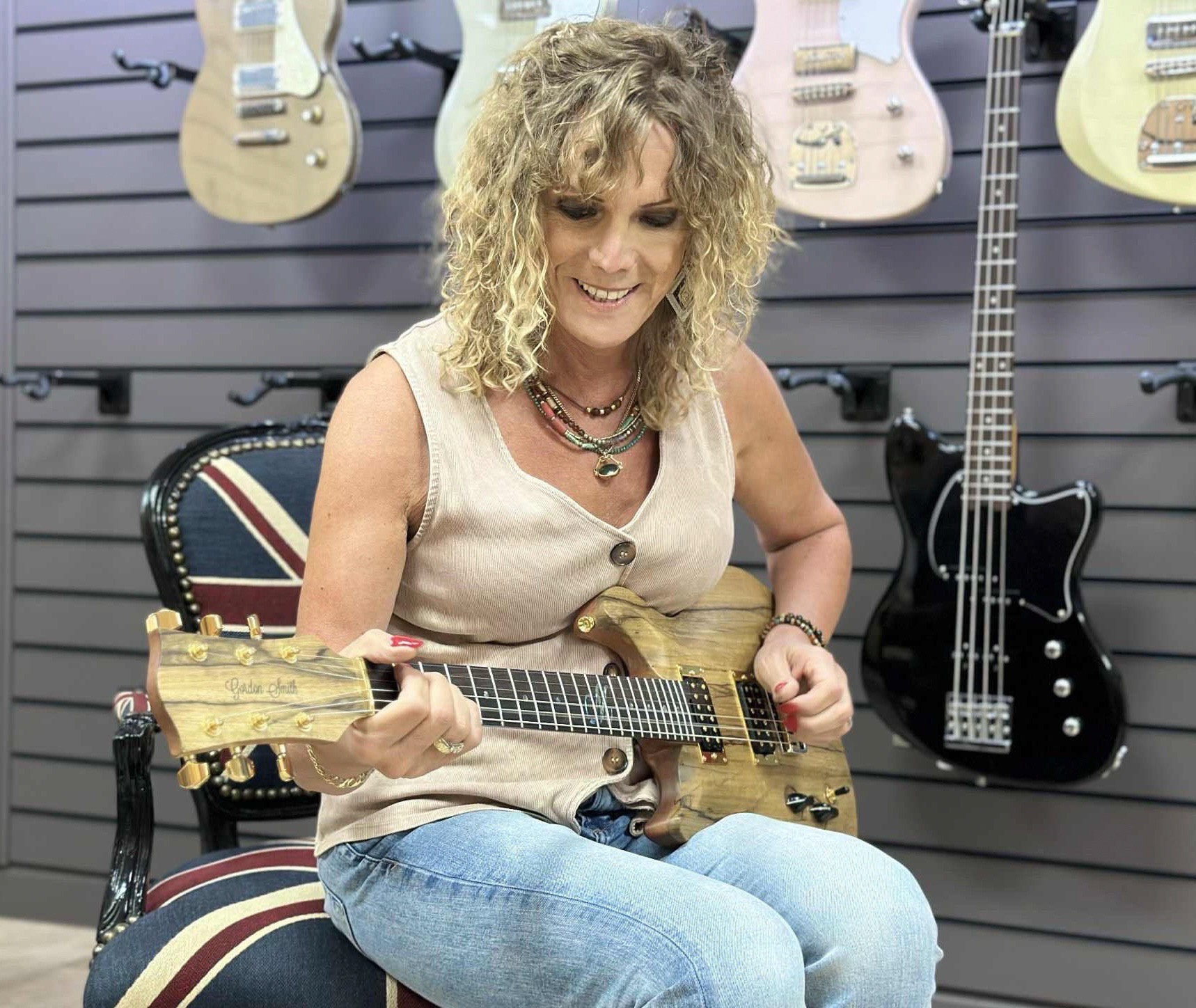
Hi everyone, I hope you all had a wonderful Christmas and New Year, and that Santa was kind enough to deliver a few pieces of nice new gear your way. This month, I’m taking a short break from talking about pedals to talk about a recent new addition to the family. It’s something that most young guitarists have probably fantasised about at some point — and no, I don’t mean Michelle Pfeiffer (or perhaps that was just me). I’m talking about the dream of having your very own signature guitar.
From a Ten-Pound Guitar to a Lifelong Journey
I remember back in the late 70’s when I was trying to teach myself to play guitar, all I had was a beaten up second hand nylon strung guitar that I’d bought from Enid the resident organist at Trimdon Village working men’s club where I was working as the resident drummer. The guitar cost me all of a tenner but it did the job. I took it home, and turned it upside down, and with my newly purchased “Elvis 40 greatest hits guitar chord book” I was good to go. At that stage I didn’t know that as a left handed person I was supposed to restring the guitar and so I simply set about trying to learn the chords shown in the book on this righty strung guitar. As a professional drummer I was already playing in a number of bands. One of the bands were playing country music, one was playing Rock, and there was even an Elvis tribute band. All of these sources together with the club residency where I was playing for many different artists meant that I was exposed to an incredible range of musical styles, and back home in my bedroom the record player was spinning everything from the Eagles and Santana to Be-Bop Deluxe and George Benson.
Inspiration Strikes
At that time there was a popular monthly music publication called “The International Musician” It was there that I first discovered the concept of signature guitars. One artist in particular stood out: George Benson. Regular adverts showcased his Ibanez semi-acoustic model, proudly bearing his name on the headstock.) remember being completely struck by the idea — the thought that you could reach a level where an instrument was designed specifically for you. It seemed like the ultimate achievement. Of course, I never imagined it would happen to me. I was a drummer after all, and I had no plans on being a guitarist. Besides, at that point I was still struggling to play a D chord. Nevertheless, I stuck with it, and over time my guitar playing improved — although mostly rhythm with the occasional fill. After years of touring across Europe as a professional session drummer playing for many American country artists, I gradually made the transition from drums to guitar. (There’s significantly less to carry.) I never particularly liked listening to or playing country music (as i found it it could become quite repetitive — but I did work alongside some exceptional guitarists.
American artists would often bring cassette tapes of the latest country hits on tour with them, playing them endlessly on the bus. I usually tuned out… until one particular solo stopped me in my tracks and made my ears prick up. Midway through a song came a blazing solo unlike anything I’d heard in country music. It was bold, structured, and aggressive — not the typical smooth, sugar-coated solo of the era. This player approached the instrument like Picasso approached a canvas, combining unexpected runs and phrasing with a completely different attitude.
I asked who it was and made a mental note to investigate later (this was long before smartphones and streaming). The album turned out to be Highways and Heartaches by Ricky Skaggs, but the solo that had captivated me was played by Nashville session guitarist Ray Flacke — who, remarkably, was originally from the UK. That was the moment. I didn’t just want to play guitar — I wanted to play like that. Or at least steal a few licks. Ray’s influence pushed me further toward the guitar and further away from the drum kit. Years later, I’m incredibly fortunate to count him as a friend. We still keep in touch online, and every now and then he’ll even send me a new lick that he’s been working on.
Enter Gordon Smith Guitars
These days, I’m extremely grateful to be endorsed by several fantastic companies — one of them being Gordon Smith Guitars. I’ve played and promoted their instruments for many years. For those unfamiliar with the brand, Gordon Smith is the UK’s longest-running electric guitar manufacturer and is often referred to as “the UK’s Gibson” — in the sense of Gibson’s heritage as a maker of premium, handcrafted instruments. Every guitar is built from raw timber in their Northampton workshop, and they even wind and pot their own pickups. Artists who have used Gordon Smith guitars over the years include Chris Buck, The Smiths, The Stone Roses, Kevin Armstrong (David Bowie, Iggy Pop), Manic Street Preachers, and Buzzcocks, to name just a few. The Gordon Smith guitars I’ve used onstage — particularly “The Owl” and “Olivia” have gained quite a following online, to the point where some players have even had right-handed replicas made. I also own an older GS1 that I picked up second-hand in the UK, though it’s very much a bare bones instrument when compared to the others.
Designing the MTS
Approximately two years ago, Gordon Smith approached me with the idea of creating a Michelle Taylor Signature model, and once I’d recovered from the initial shock, I was absolutely thrilled. Rather than adapting an existing model or opting for another double-cut custom design like my previous GS guitars, I wanted to start from scratch with all the features that are important to me. My goal was to create a premium instrument that reflected my needs as a working musician, while still being something others would appreciate for its beauty and practicality.
I worked closely with Elliot at Gordon Smith, sharing sketches and ideas, receiving feedback on what was practical, what needed adjustment, and what couldn’t be done for technical or copyright reasons. We went back and forth for months, gradually evolving until the final body shape was agreed upon. At the same time, I was regularly playing a guitar built for me by North East luthier Trevor Spooner. Trevor had secretly designed it as a surprise gift, subtly incorporating features I’d mentioned in passing. Based loosely on a PRS-style shape, it featured smaller offset horns, a slimline body, and a natural wood finish. It was incredibly comfortable to play, and I found myself reaching for it often. That comfort became central to the MTS design. I wanted a slimline guitar that felt like an old, well-worn pair of shoes — familiar, effortless, and reliable. Although it wasn’t a traditional double-cut, easy upper -fret access was essential, so a contour was added. And, thanks to my mild OCD, a matching contour was added to the opposite side for balance. Trevor had also introduced me to IronGear Humbuckers — a British pickup company that I hadn’t ‘ previously used. The sound was instantly “me,” which opened my eyes to just how good they were.
Built for the Working Musician
The MTS guitar was designed with live performance firmly in mind. No unnecessary bells and whistles just organic, practical controls. I’ve always preferred a single master volume and tone control. Onstage, simplicity is key, no juggling multiple knobs, just quick access to the sound you need. Combined with a standard three-way pickup selector positioned close to the controls rather than further away on the body — everything is within easy reach. All controls are subtly recessed for comfort and nice aesthetics too. The pickups on the MTS are Gordon Smith’s own double-black humbuckers with gold screws, wound in-house and mounted in gold surrounds. Im, not always a fan of gold hardware but together with the wood used it looks amazing. Working with the Gordon Smith team throughout this whole process was an absolute pleasure. I vividly remember flying to the UK and visiting the workshop and being handed the body of the first prototype — even then it felt incredibly comfortable in the hands and looked great. I felt like a kid. I was excited and couldn’t wait to get the finished instrument in my hands. Nearly two years later, I returned to their new workshop to be officially presented with the finished instrument. Doug had it hidden and asked me to close my eyes and hold out my arms. When I opened them, it was everything I’d hoped for — beautiful, perfectly balanced, and inspiring to play. I set it down on a chair decorated with a Union Jack so I could step back and take it all in. I genuinely loved it. We finished the day with a photoshoot, some PR images, and a short video. It was a special experience — one I’ll never forget.
Visit the Workshop
Gordon Smith offer factory tours for anyone interested. All you need to do is contact them to arrange a suitable date and time. I can’t recommend it highly enough — seeing how these instruments are made and trying them for yourself is a real treat. Tell them Michelle sent you… and that you’d like a cuppa
Michelle Taylor Signature (MTS) – Specifications
• Custom carved and contoured top and back • Slimline mahogany body
• Black Limba cap • Open-pore satin finish
• Matching Black Limba headstock • Thin mahogany neck • Rosewood fretboard • Custom long-tenon style neck joint
• Oval jack output shaped to rear carve • Chrome Relish hardtail bridge with gold Relish saddles
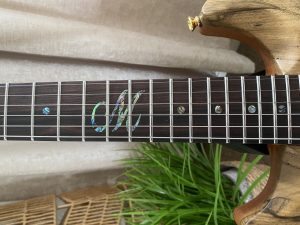
• Gold Gotoh 1 8:1 locking tuners • Recessed chicken-head knobs • Gold pickup surrounds • Choice of abalone dot inlays or custom “M” signature inlay • Stainless steel frets • CTS wiring loom
• No scratchplate • 9-46 gauge strings
• Available in both right- and left-handed models